Fort Heritage Walk: A Self-Guided Route Through Old Bombay
Thirteen buildings between CSMT and Churchgate, about 4.5 km on foot, with the story behind each one
- Duration
- Half day
- Theme
- Heritage
- Budget
- Free to walk; museum entry and lunch extra
- Best for
- Architecture and history, Photographers, Sunday mornings
The British East India Company walled in its town on Bombay island between 1686 and 1743. The walls came down in the 1860s, and most of what you see on this walk went up in the decades after, as the city filled the old fort and the open ground beside it with offices, courts, banks and a university. In the 1930s a second wave of building on reclaimed land added the Art Deco flats that face the High Court across the Oval Maidan.
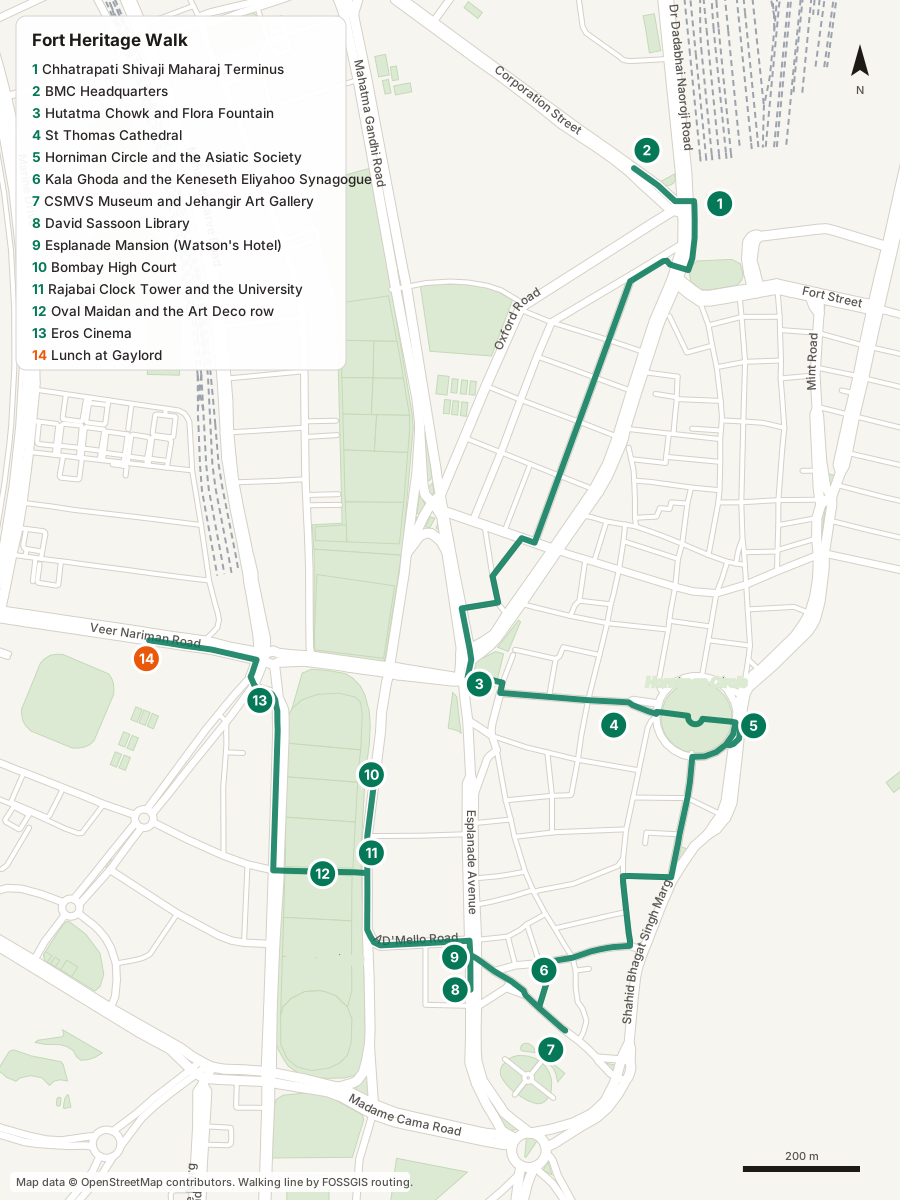
The route starts at Chhatrapati Shivaji Maharaj Terminus and ends at Churchgate station, so you can arrive and leave by suburban train or Metro Line 3. It covers about 4.5 km and takes four to four and a half hours at a gentle pace, longer if you go into the museum. Each stop below says what you are looking at, who built it and one story worth knowing. Print the page or save it as a PDF before you set out, and you will have the map and every stop without needing signal.
Route map
The plan
Chhatrapati Shivaji Maharaj Terminus: Chhatrapati Shivaji Maharaj Terminus (CSMT)
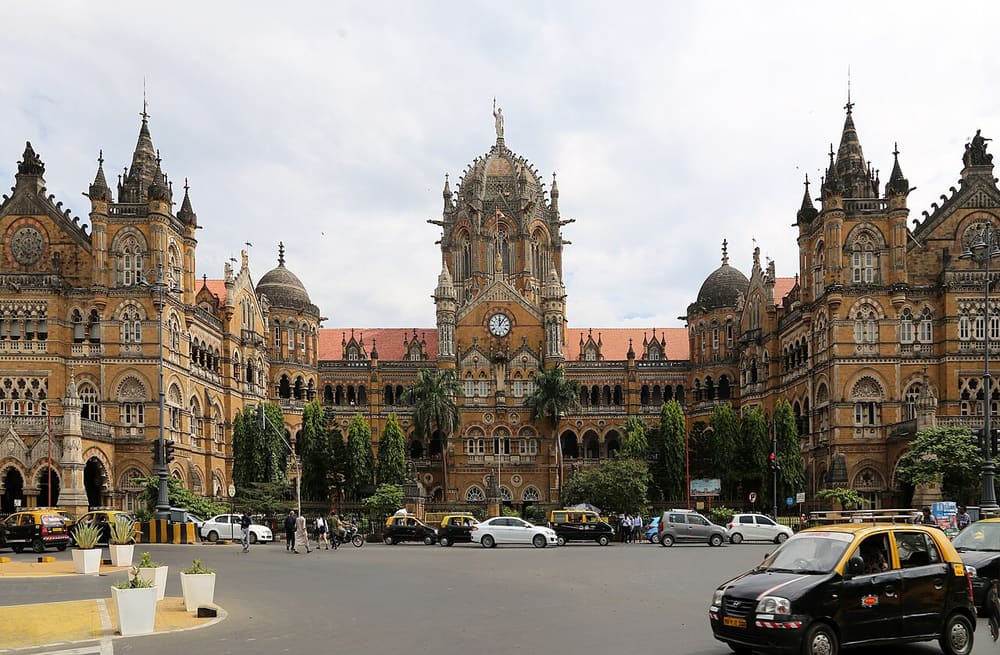
The station opened in 1888 as Victoria Terminus, named for Queen Victoria's Golden Jubilee the year before. Frederick William Stevens designed it, and it took ten years to build. It replaced Bori Bunder, the small station the Great Indian Peninsula Railway had used since 1853.
The best view of the front is from the traffic island opposite the main entrance. The figure on top of the dome holds a torch and a spoked wheel. She is Progress, though people often take her for Queen Victoria. The lion and the tiger on the gateposts stand for Britain and India. Much of the carving on the arches, the foliage and the grotesque faces, was done by students of the Sir J. J. School of Art under John Lockwood Kipling, the father of Rudyard Kipling.
The station became Chhatrapati Shivaji Terminus in 1996, and Maharaj was added to the name in 2017. UNESCO made it a World Heritage Site in 2004. On 26 November 2008 two gunmen opened fire in the passenger hall and killed 58 people; a railway announcer's warnings over the speakers helped many others get out.
BMC Headquarters
The city corporation's headquarters faces the station across the junction, and it is by the same architect. Stevens's Gothic design was chosen over an Indo-Saracenic one by Robert Fellowes Chisholm, and the finished building takes something from both. The Viceroy, Lord Ripon, laid the foundation stone in 1884, and it was completed in 1893.
Look up at the gable over the entrance. The winged figure there stands for "Urbs Prima in Indis", the first city of India, as Bombay was known then, with the corporation's coat of arms below her. The tower is 77.7 m (255 ft) tall.
Hutatma Chowk and Flora Fountain: Flora Fountain (Hutatma Chowk)
You are standing about where Church Gate stood, one of the gates in the wall of the British fort. The wall was built between 1686 and 1743 and pulled down in the 1860s, as part of the Governor Sir Bartle Frere's sanitation and town improvement work. The fountain went up on the gate's site in 1864.
It was meant to be named after Frere, but before it was unveiled the name was changed to Flora, the Roman goddess of flowers and spring. Richard Norman Shaw designed it and James Forsythe carved it in Portland stone. The Agri-Horticultural Society of Western India paid for it with a ₹20,000 gift from Cursetjee Fardoonjee Parekh. The four women at the corners are the four seasons.
The square's official name is Hutatma Chowk, Martyrs' Square. In November 1955 police fired on a Samyukta Maharashtra demonstration here, during the campaign for a Marathi-speaking state that would include Bombay. The memorial beside the fountain, a figure holding a flame, was added in 1961 and names the 106 people who died in the movement. Maharashtra was formed on 1 May 1960.
St Thomas Cathedral
The road you just walked ran from Church Gate to this church, which is how the gate, and later Churchgate station, got its name.
Gerald Aungier, Governor of Bombay, had the foundation stone laid in 1676 on what was then Bombay Green. More than forty years passed before the chaplain Richard Cobbe finished the building, and it opened on Christmas Day 1718. It is the oldest church in Mumbai and has held Anglican services ever since. It became a cathedral in 1837, when Thomas Carr was made the first Bishop of Bombay, and the tower and clock were added the next year.
If the doors are open, read the memorials on the walls. One remembers the steamship Cleopatra, lost in April 1847 with 100 convicts on board. After a long restoration the cathedral was chosen for a UNESCO Asia-Pacific heritage conservation award in 2004.
Horniman Circle and the Asiatic Society
In the 18th century this was Bombay Green, open ground inside the fort. The round garden was planned in 1869 and finished in 1872, and it was long called Elphinstone Circle. After independence it was renamed for Benjamin Guy Horniman, the British editor of The Bombay Chronicle from 1913, who backed the independence movement. The colonial government deported him to London after he printed a smuggled report on the Jallianwala Bagh massacre. He came back in 1926.
The white building with the long flight of steps is the Town Hall, finished in 1833 to a Neoclassical design by Colonel Thomas Cowper of the Bombay Engineers. Thirty steps lead up to a portico of eight Doric columns, built in stone brought from England.
It is home to the Asiatic Society of Mumbai, which Sir James Mackintosh founded as the Literary Society of Bombay. It first met on 26 November 1804. The library holds more than 100,000 books, over 3,000 old manuscripts and nearly 12,000 coins, among them coins issued by Chhatrapati Shivaji Maharaj. Its best-known treasure is a 15th-century illustrated manuscript of Dante's Divine Comedy, given by Mountstuart Elphinstone. The story goes that Mussolini's government offered a million pounds for it in the 1930s and the society said no. The library is generally open to members only.
Kala Ghoda and the Keneseth Eliyahoo Synagogue: Kala Ghoda Art District
Kala Ghoda means black horse. The name comes from a black stone statue of King Edward VII, then Prince of Wales, on horseback, which stood here until 1965 and now stands in the Byculla zoo. The area kept the name. In 2017 the Kala Ghoda Association put up a new horse with no rider, the Spirit of Kala Ghoda, designed by Alfaz Miller and sculpted by Shreehari Bhosle.
The white building with indigo trim on Dr V B Gandhi Marg is the Keneseth Eliyahoo Synagogue, finished in 1884. Jacob Sassoon, grandson of the merchant David Sassoon, paid for it and named it after his father, Eliyahoo. It is still a working synagogue for the city's Baghdadi Jewish community. The front was grey at first and then turquoise, which made it the Blue Synagogue to most of Mumbai. The 2018 to 2019 restoration by the conservation architect Abha Narain Lambah left it white with indigo borders.
People of all faiths can visit. Carry photo ID, as there is a security check at the gate.
CSMVS Museum and Jehangir Art Gallery: Chhatrapati Shivaji Maharaj Vastu Sangrahalaya
The domed building in the garden opened in 1922 as the Prince of Wales Museum of Western India. The prince, later King George V, laid the foundation stone in 1905. George Wittet, who also designed the Gateway of India, won the design competition. His building mixes Mughal, Maratha and Jain elements in the Indo-Saracenic style. It was finished in 1915 but served as a military hospital and a children's welfare centre during the First World War before the museum moved in. It was renamed Chhatrapati Shivaji Maharaj Vastu Sangrahalaya in 1998 and holds about 50,000 objects.
Fifteen minutes won't do it justice, so either look at the building from the garden and come back another day, or give it two hours now. It opens at 10:15 AM.
Jehangir Art Gallery, next door, was founded by Sir Cowasji Jehangir and opened in January 1952. Entry is free, and the artists who line the pavement outside sell their own work.
David Sassoon Library
The library grew out of the Mechanics' Institution, set up in 1847 by European workers at the government mint and dockyard. This building, finished in 1870, cost ₹1,25,000; David Sassoon gave ₹60,000 of it and the government paid the rest. It is built of yellow Malad stone, with Burma teak inside.
The bust over the porch is the sculptor Thomas Woolner's working model for his marble statue of Sassoon. A restoration finished in 2023 put back the original sloping roof in place of a concrete slab added after the 1960s. The library is part of the UNESCO World Heritage Site of Victorian Gothic and Art Deco buildings listed in 2018.
Esplanade Mansion (Watson's Hotel)
This worn building is India's oldest surviving cast iron building. It opened in 1871 as Watson's Esplanade Hotel. The engineer Rowland Mason Ordish, who had worked on the Crystal Palace in London, designed it, and its iron frame was made at the Phoenix Foundry in Derby and shipped out to be put together here.
Watson's is said to be where India first saw the Lumière brothers' films, in 1896. You may also hear that it turned away Jamsetji Tata, and that he built the Taj Mahal Palace hotel in reply. Historians, Sharada Dwivedi among them, call that a myth.
The building is in poor shape. Part of the west facade collapsed in 2005, killing one person, and its restoration has been debated for years since.
Bombay High Court
The court was set up in 1862 under letters patent from Queen Victoria. This building came later. The British engineer Colonel James A. Fuller designed it in the Gothic Revival style, work ran from 1871 to 1878, and the first sitting here was in January 1879. It is 171 m (562 ft) long. Look for the statues of Justice and Mercy on the top.
Rajabai Clock Tower and the University
The tower is 85 m (280 ft) tall, and when it was finished in 1878 it was the tallest structure in the city. Sir George Gilbert Scott designed it, and people often compare it to Big Ben. Premchand Roychand, a wealthy broker who founded the Bombay Stock Exchange, paid part of the ₹5,50,000 it cost, on condition that it carry his mother's name, Rajabai.
The story most guides tell is that Rajabai was blind and, as a devout Jain, had to eat before dark, so the evening bell told her the time without her having to ask anyone. It is a legend, not a documented fact. In the 19th century the bells played one of sixteen tunes, "Home! Sweet Home!" among them; now they chime every 15 minutes. The tower is closed to visitors.
Oval Maidan and the Art Deco row
Stop in the middle of the Oval and turn round. Behind you is a line of Victorian Gothic: the High Court, the University and the old Secretariat. In front, along Maharshi Karve Road, is a line of Art Deco flats. In 2018 UNESCO listed the two sides together as the Victorian Gothic and Art Deco Ensembles of Mumbai.
The Oval was once part of the Esplanade, the open ground west of the old fort. The flats stand on land reclaimed from the sea under the Backbay Reclamation Scheme, which began in 1928. They went up in the 1930s and 1940s for the city's business families, five or six storeys high, with curved balconies, sunburst patterns and porthole windows borrowed from ocean liners. The experts who assessed them for UNESCO in 2018 called them one of the largest and most uniform groups of Art Deco buildings in the world.
A few to look for: Empress Court, designed by Gajanan B. Mhatre, whose long curves take after the cars of its day; Belvedere Court, with a "frozen fountain" in its window grilles; and Court View, whose first floor carries an R for its old name, Rusi Court.
Eros Cinema
Eros opened on 10 February 1938 on a triangular plot opposite Churchgate station. The Parsi businessman Shiavax Cawasji Cambata commissioned it and Shorabji Bhedwar designed it, with stepped towers, red Agra sandstone and cream paint. Besides the cinema it had a ballroom, a restaurant, shops, offices and an ice rink.
It was closed for several years and reopened in February 2024. Churchgate station is across the road, so the walk ends here.
Lunch at Gaylord: Gaylord Restaurant
Gaylord, on Veer Nariman Road, opens at 9:30 AM, so it suits a late breakfast as well as lunch. It does Continental and North Indian food, with tables indoors and outside. For a Gujarati thali instead, Samrat is a few minutes away and opens at noon.
Before you go
- Start by 8 AM. Sunday mornings have the least traffic.
- Wear comfortable shoes and carry water.
- Kyani & Co, an Irani cafe near Dhobi Talao from 1904, opens at 7 AM and is about 10 minutes' walk west of CSMT if you want breakfast first.
- Crawford Market (Mahatma Jyotiba Phule Mandai) is 10 minutes north of CSMT if you want to add it. It is mostly closed on Sundays.
- Carry photo ID for the Keneseth Eliyahoo Synagogue. There is a security check at the gate.
- Tours of the CSMT Heritage Gallery run on weekday afternoons, so on a morning walk you will see the station from the outside and the main hall.
Sources and further reading
- UNESCO: Chhatrapati Shivaji Terminus (formerly Victoria Terminus)
- UNESCO: Victorian Gothic and Art Deco Ensembles of Mumbai
- Wikipedia: Chhatrapati Shivaji Terminus
- Wikipedia: Brihanmumbai Municipal Corporation Building
- Wikipedia: Flora Fountain
- Wikipedia: Hutatma Chowk
- Wikipedia: St. Thomas Cathedral, Mumbai
- Wikipedia: Horniman Circle Gardens
- Wikipedia: B. G. Horniman
- Wikipedia: Town Hall, Mumbai
- Wikipedia: Asiatic Society of Mumbai
- Wikipedia: Kala Ghoda
- Wikipedia: Knesset Eliyahoo Synagogue
- Rotary Club of Bombay: Visiting the Keneseth Eliyahoo Synagogue
- Wikipedia: Chhatrapati Shivaji Maharaj Vastu Sangrahalaya
- Wikipedia: Jehangir Art Gallery
- Wikipedia: David Sassoon Library
- Wikipedia: Esplanade Mansion (Watson's Hotel)
- Wikipedia: Rajabai Clock Tower
- Wikipedia: Bombay High Court
- Wikipedia: Oval Maidan
- Art Deco Mumbai on Google Arts & Culture: The Rise of Art Deco in Oval Maidan
- Abha Narain Lambah, Heralding India moderne: Art Deco in Mumbai (Seminar, 2019)
- Wikipedia: Eros Cinema