Matunga: A Neighbourhood Guide (2026)
Matunga is Mumbai’s South Indian quarter. Families from Tamil Nadu, Karnataka and Kerala settled here from the 1920s and brought their temples, coffee and breakfast with them. A century on, the streets between Matunga Central station and King’s Circle hold the densest run of old Udupi restaurants in the city, a coffee shop that has been grinding beans since 1939, and a temple whose community has worshipped here since 1923.
Come hungry, come early, and come on a weekday if you can. This is a neighbourhood best seen between six and ten in the morning.
The short version
- Getting there: Matunga on the Central line puts you on the east side, in the middle of it all. Matunga Road on the Western line and King’s Circle on the Harbour line are both a 10 to 15-minute walk away.
- Time needed: a morning
- Best time: from 6:30 AM. The best-known rooms open early and the queues build by eight. Most of them close by evening.
- Good to know: each restaurant takes a different day off. Check before you travel, or the one you came for may be the one that is shut.
A Matunga breakfast trail
This route starts at the station and works around the old cafes, the coffee shop and the temples. It takes two to three hours at an eating pace. Share plates; there is a lot to try.
- Sharda Bhavan. Directly across from Matunga Central station, and the calmest of the old rooms: chequered floor, stone-topped tables, waiters in lungis and no menu cards. A good first stop for idli and coffee before the famous names fill up.
- Ram Ashraya. Trading since 1939 and the counter most Mumbai breakfast arguments end at. There is no printed menu, just a blackboard. It opens at 5:30 AM, and the queue outside by eight is part of the experience. Order whatever is chalked up as the day’s special.
- Cafe Madras. Open since 1940, near King’s Circle, and as famous for its filter coffee as its dosas. Expect to wait at weekends.
- Anand Bhavan. An old room at Maheshwari Udyan on King’s Circle, known among regulars for its benne dosa. Service is quick and brusque.
- Mysore Concerns. A small family-run shop on Sri Shankar Mutt Road that has been grinding filter coffee since 1939, from beans grown in Karnataka, Andhra Pradesh and Kerala, and supplies some of the cafes around it. The smell reaches you before the shop does. Buy a bag of coffee powder to take home; it is the best souvenir Matunga has. It is closed on Mondays.
- The Asthika Samaj temple. Founded in 1923 by families from Palakkad in Kerala, who began by worshipping before a portrait of Lord Rama in a hall; the temple itself was consecrated in 1953. It is still the heart of the community. Visitors are welcome; take your shoes off and dress modestly.
- Amba Bhavan Coffee Club. A tall-ceilinged, wood-panelled room next to the temple on Bhandarkar Road, pure vegetarian for over eighty years and reliably the emptiest of the old addresses.
Lunch: a banana-leaf thali
If you stay on, go to Udipi Shri Krishna Boarding, a first-floor thali hall a minute from Matunga Central that has run for more than eighty years. It is not a dosa counter: you buy a token at the door, sit down, and are served rice, sambar, rasam, vegetables and payasam on a banana leaf, refilled until you stop.
For the late or hungry, Ayyappan Idli on Bhaudaji Road is open from 7 AM to 11 PM with the widest range of idli and dosa in the area, including thatte idli and a run of modern fusion dosas.
See every restaurant we list here on our Matunga restaurants page.
What to order
- Idli and vada: steamed rice cakes and fried lentil doughnuts, with sambar and chutney.
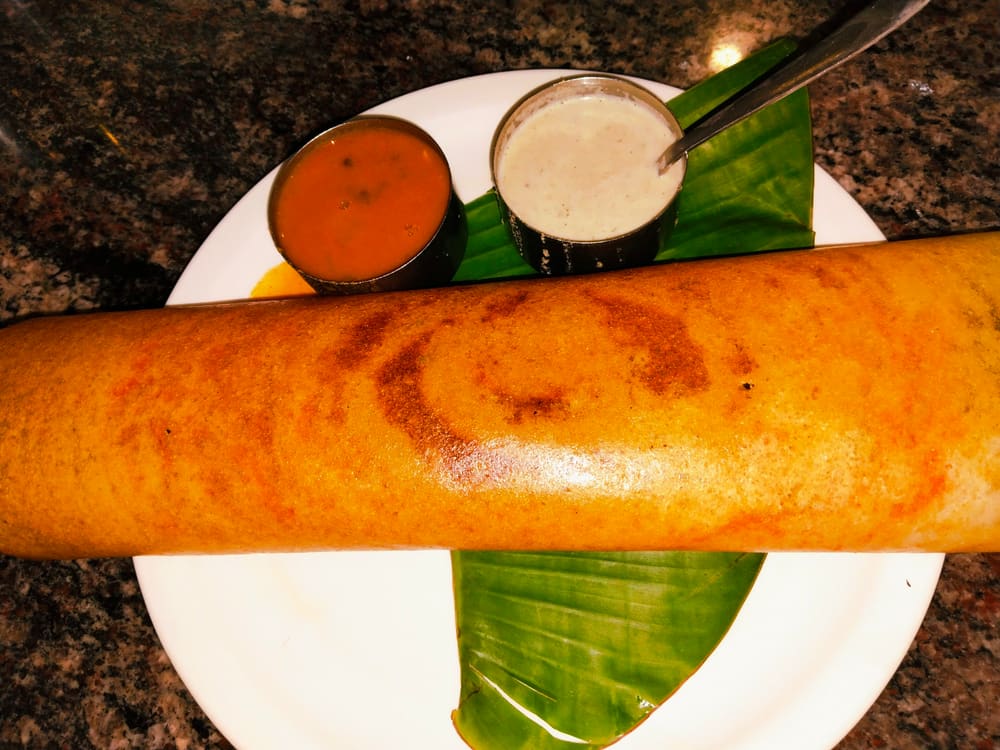
- Dosa: the classic crisp crepe. Try a benne (butter) dosa, a Mysore masala dosa with red chutney inside, or a rava dosa.
- Upma and sheera: savoury and sweet semolina, the old breakfast staples.
- Filter coffee: strong, milky and frothed by pouring between a tumbler and a bowl. Drink it hot.
Shopping
The streets around the station sell what the community cooks and prays with: flower garlands, banana leaves, South Indian spices and podis, steel utensils and brass lamps. It is a working market, not a tourist one, and that is the point.
Practical notes
- No air-conditioning, mostly. The old rooms are fans and open doors. In April and May, go as early as you can.
- Shared tables. You will be seated with strangers, and you will be expected to eat and go. This is a feature, not rudeness.
- Cash and cards. Carry cash, though most places now also take UPI.
- Getting on. Dadar and Shivaji Park are one station south, and Siddhivinayak is a short taxi ride away.
Sources
- Wikipedia, Matunga: https://en.wikipedia.org/wiki/Matunga
- LBB on Mysore Concerns: https://lbb.in/mumbai/mysore-concerns/
- The Asthika Samaj, about the temple: https://theasthikasamaj.com/about-us/
Header photo: A masala dosa by Yakshitha, CC BY-SA 4.0, via Wikimedia Commons.