Lonavala from Mumbai: Karla Caves, Forts, Monsoon Rules and Chikki
Lonavala is the hill station everyone in Mumbai has been to: two hours up the road to Pune, in the hills of the Western Ghats, famous for chikki, monsoon waterfalls and weekend traffic. Its own sights are mostly viewpoints, but the hills around it hold some of the finest early Buddhist caves in India and a string of Maratha hill forts, and in the rains the whole range turns green and runs with water. Go for the caves and the forts, and you will understand why people keep coming back.
The town and its neighbour Khandala were developed as hill stations in 1871, under the Governor of Bombay, Lord Elphinstone.
The short version
- Getting there: an express train from CSMT or Dadar, about two to two and a half hours, or by road on the Mumbai–Pune Expressway.
- Time needed: a long day, or a night
- Best time: the monsoon, June to September, for green hills and waterfalls, with crowds and restrictions; October to February for clear views and treks. Go midweek.
- Good to know: in the monsoon, the Pune district administration bans entry into waterfalls, dams and streams around Lonavala. Respect it: people drown here.
Getting there
By train. Several express trains a day between Mumbai and Pune stop at Lonavala, from CSMT and Dadar; check times on the RailOne app and book ahead at weekends. From Lonavala, the Pune–Lonavala local trains run east to Malavli, one stop and a few minutes away, the station for the Bhaja Caves and Lohagad.
By road. The Mumbai–Pune Expressway now uses the new “missing link” between Khopoli and Kusgaon, opened on 1 May 2026, which bypasses the old Khandala ghat through a pair of tunnels and saves 25 to 30 minutes. Landslides closed part of it for some hours in July 2026, so in heavy rain check the traffic before you set off. Weekend traffic out of Mumbai on Saturday mornings, and back on Sunday evenings, is heavy whichever way you go.
Getting around. Autos and taxis wait outside Lonavala station; agree a price for a half-day or full-day loop of the sights before you start.
The Buddhist caves
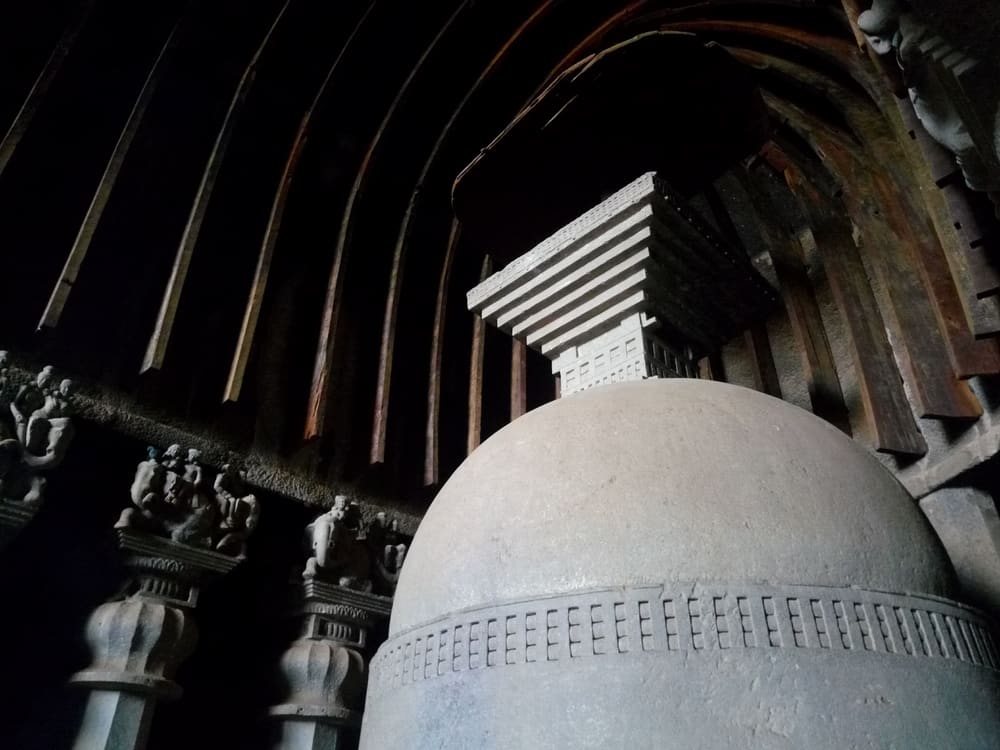
Karla Caves. About 11 km east of Lonavala, cut into a hillside from around the 2nd century BCE. The great chaitya hall, Cave 8, is the largest and most completely preserved of its period in India: a vaulted prayer hall with a ceiling ribbed in timber, pillars topped with carved elephants and riders, and a stupa at the far end. Traders and kings paid for the caves because they stood on an ancient trade route from the coast into the Deccan. It is a steep climb of a few hundred steps, past the busy Ekvira temple, and there is a small ASI entry fee, about ₹25 for Indian visitors and ₹300 for foreign visitors.
Bhaja Caves. Across the valley, about 2 km from Malavli station, a group of 22 caves also from the 2nd century BCE, quieter than Karla. Look for the cluster of stupas carved from the rock, and for the relief of a woman playing a tabla, evidence that the drum has been played in India for more than two thousand years.
The forts
Lohagad. A hill fort above Bhaja at about 1,000 metres, held by Chhatrapati Shivaji Maharaj, who kept treasure here, and later by the Peshwas. A well-trodden path with steps climbs to it from the village of Lohagadwadi, which makes it one of the easier fort walks near Lonavala. Visapur fort stands on the next hill.
Rajmachi. Twin forts, Shriwardhan and Manaranjan, on a plateau north of Lonavala, reached by a long walk or trek from Lonavala or from the Karjat side. It is best done with a group or a local guide.
Viewpoints, lakes and the rest
- Tiger’s Point and Lion’s Point: cliff-edge viewpoints over the valleys, packed at weekends and in the monsoon, when clouds pour over the edge. Stay behind the railings; filming at cliff edges is banned in the monsoon order.
- Bhushi Dam: the famous monsoon spot where water flows over the steps. In 2024 a family was swept away by a stream nearby, and since then entry into the water has been banned each monsoon.
- Pawna Lake: a reservoir about an hour from Lonavala, ringed by tent camps that sell overnight packages. Swimming is not allowed.
- Imagicaa: a theme park and water park at Khopoli, on the way from Mumbai, if you have children with you.
Chikki and fudge
Lonavala is the home of chikki, brittle bars of jaggery with peanuts, sesame or dry fruit. Maganlal, whose founder opened a sweet shop opposite the station around 1888, is the name most associated with it; many shops now use the same name, so if you want the original, look for the shop facing the station. Cooper’s, near the station, has made fudge for decades; the chocolate walnut fudge is the one to buy.
Practical notes
- Monsoon rules. In 2026 the Pune collector’s order, from 6 to 31 July, banned entry into waterfalls, streams, rivers and dams, selfies and filming at dangerous cliff edges, alcohol and loud music at Bhushi Dam, Lion’s Point, Tiger Point, Pawna Dam, Lohagad, Visapur and other spots. Expect similar orders every monsoon.
- Treks in the rain. Paths get slippery and streams rise in minutes. Go with an established group, wear proper shoes, and turn back if the water is high.
- Crowds. Weekends from June to September are very busy at every viewpoint, and the roads back to Mumbai jam on Sunday evenings. Go midweek, or start early.
- Staying over. Lonavala and Khandala have hotels, resorts and villas at every price, and fill up on monsoon weekends; book ahead.
- More day trips. Our day trips guide compares Lonavala with Alibaug, Matheran and the rest, and our full guides to Alibaug and Matheran cover the other two favourites.
Sources
- Wikipedia, Lonavala: https://en.wikipedia.org/wiki/Lonavala
- Wikipedia, Karla Caves: https://en.wikipedia.org/wiki/Karla_Caves
- Wikipedia, Bhaja Caves: https://en.wikipedia.org/wiki/Bhaja_Caves
- Wikipedia, Lohagad: https://en.wikipedia.org/wiki/Lohagad
- Wikipedia, Rajmachi: https://en.wikipedia.org/wiki/Rajmachi
- Wikipedia, Malavli railway station: https://en.wikipedia.org/wiki/Malavli_railway_station
- Wikipedia, Mumbai–Pune Expressway, on the missing link: https://en.wikipedia.org/wiki/Mumbai–Pune_Expressway
- Social News XYZ on the 2026 monsoon order for Lonavala, 6 July 2026: https://www.socialnews.xyz/2026/07/06/pune-district-imposes-monsoon-safety-curbs-in-lonavala-till-july-31/
- Wikipedia, 2024 Lonavala waterfall tragedy: https://en.wikipedia.org/wiki/2024_Lonavala_waterfall_tragedy
- Maganlal Chikki, history: https://maganlal.com/history.html
- Kalyan Karmakar, Finely Chopped, on Cooper’s fudge: https://finelychopped.net/for-the-love-of-chocolate-chocolate-walnut-fudge-at-coopers-lonavla/
- Imagicaa, park timings: https://www.imagicaaworld.com/park-timings/
Header photo: The stupa in the great chaitya hall at Karla by Abhijeet Safai, CC BY-SA 4.0, via Wikimedia Commons.